Career Change: How to Change Careers and Work More Remotely

Short Summary
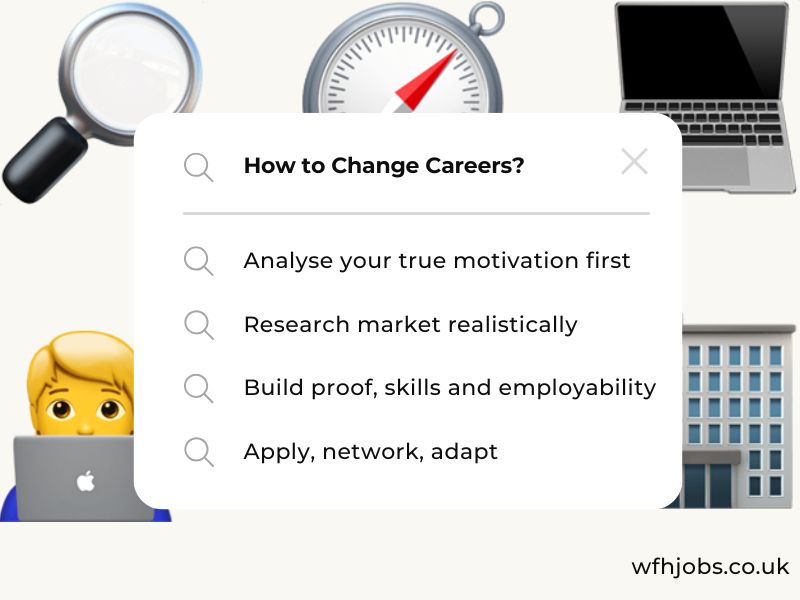
- Before changing careers, make sure it is the career itself you want to leave, rather than your employer, workload, pay or circumstances outside work.
- Do not romanticise your new career. Look beyond what makes it appealing and consider the compromises that may come with it.
- Research prospective careers against the realities of the job market, including available opportunities, earning potential, competition and long-term demand.
- Identify the transferable skills you already possess, then use real job descriptions to pinpoint and prioritise what you still need to learn.
- Build tangible proof that you can do the job, tailor your CV around relevant experience and prepare a convincing case for why an employer should hire you despite your lack of formal experience.
- Prepare financially and mentally for the transition. Changing careers can mean months (yet even years) of learning, rejection and self-doubt.
Introduction

It is easy to romanticise a career change. Chances are, you might have heard great accounts of people who went from, say, engineering to copywriting or from administration to software development, and found success.
Sometimes, they went on to enjoy colossal success, earning more in their new career than they ever did in their old one or climbing the career ladder in a remarkably short time.
But what we do not see from the outside looking in are the struggles and the price they had to pay to make that transition.
So, if you are sitting there thinking, ‘I need a new job’, this guide will walk you through how to decide whether a career change is actually right for you, prepare for the transition and find remote work in your new field.
I Need a New Job: What You Should Look Out For

Make sure it is your career you want to leave, not just your current job.
Often, when I am deeply focused working on my work, designing roadmaps, assessing cyber risks of my costumers or answering emails, it is always a surprising call from my clients that completely disrupt my entire workflow.
In these situations, I am guilty to think about changing careers; especially if my customer is disrespectful of my time or demands unrealistic expectations for the same day.
For me though, once the flames of disruption and irritation had died down and I had allowed myself a period of introspection, I often come back to the same issue: I feel overwhelmed, yet even burned out, but I do not despise my own job.
So, before making any rash decisions, I calm down and ask myself how I truly feel.
My point is that before you consider changing careers, try to separate what you dislike about your career from everything else that might be making you unhappy at work.
Understand your root problem.
If your problem is an overbearing manager, an unreasonable workload or poor pay, moving to another company might solve it.
If you remain dissatisfied with the actual work even under better circumstances, then you have a stronger reason to consider a different career.
Unless you absolutely have to make a decision immediately, give yourself time to sit with it.
Do not romanticise the career you are moving into.
One thing I have realised from talking to thousands of our subscribers about their professional lives is that many of them are willing to change careers simply for the opportunity to work remotely. I get it. I am also a huge believer in wfh jobs.
Working from home allows you to skip the commute and spend that time instead on personal development or with your family. Personally, my sickness cystic fibrosis (which makes me more susceptible to infections and illnesses) has given me a clear reason to work remotely and better protect my health.
But at the same time, remote work has its cons, and these can easily disappear beneath the glittery shine of its advantages.
Without the structure of an office, you could just as easily lose an unhealthy amount of time doom-scrolling on social media or bingeing Netflix when you are supposedly on shift. Basically, you could end up recreating the very poor quality of life you hoped remote work would help you escape.
This is not to mention that you could be starting again in an entry-level role, for considerably less money than you are used to earning, while potentially becoming a complete nobody.
As with many decisions, changing careers brings to mind a simple truth: in life, there is no such thing as good or bad. Only actions and their inevitable results.
So, before you take the plunge, make sure to weigh the appeal of the new career against the compromises it may demand.
The main point I want to get across is this question: "What is the worst aspect of this new career? Can I endure or bear with these cons?"
How to Decide What Career to Change To

People change careers for all sorts of reasons.
For some, it is to escape the mundaneness of their 9-to-5 and chase after one that makes them feel invigorated. A friend of mine, for example, pivoted from a highly social, customer-facing job to something she had been drawn to since her teenage years: academia. Sure, she had to transition into a student accomodation in Cambridge (my alma mater) at mid-30s to do her post-doc without any 100% promise that she will continue her career and become a professor.
Yet, I respect her decision as she committed to her research and truly believes it will help people.
This is the essence of a prepared career change: Have a clear why you want to switch, understand the drawbacks and accept them.
Your hobbies, passions, target salary range and existing skills are all good starting points for deciding your next career.
But weighing personal preferences without reckoning with the material constraints of reality is, well, wishful thinking.
That is to say, eventually you have to ask yourself the hard questions:
- Are there actually opportunities in the career you want?
- Is there enough demand for people with those skills?
- If there is, what does the competition look like? Can you realistically compete?
- Are companies willing to pay what you expect? If not, are you willing to accept what they do pay?
- Is this career projected to remain in demand? Or are you staking your future on a trend that may eventually fade?
Research should therefore be a major part of deciding what career to change to. It grounds your aspirations in what is truly happening in the job market.
As such, you should search real vacancies for the careers you are considering and assess the volume of opportunities, how much they typically pay and what skills or qualifications employers require for the role.
You can also Google terms along the lines of ‘best careers to change to’ and note which careers remain in demand or are expected to grow in the coming years, then compare those findings against what you see in actual job listings.
By the end of your research, you should have a clearer idea of whether your chosen career is worth pursuing – or whether changing careers makes sense for you at all.
Assess Your Skills for Your New Career
Identify transferable skills
Changing careers does not necessarily mean starting completely from scratch. You may be lacking the technical experience of someone who has spent years in your new field. But you could also be offering a relevant, and even unique, skill set from your previous career.
If you are a teacher transitioning into project management, for example, your ability to coordinate multiple competing deadlines can definitely be an asset in keeping projects on track.
Soft skills, particularly clear communication, are among the most universally transferable skills across industries. As renowned communication coach Vinh Giang says, ‘You are only as good as you can communicate.’
Along with communication are soft skills such as leadership, critical thinking, creative thinking and negotiation. Think about which of these you have developed throughout your previous career and specific situations in which you have demonstrated them.
And since these are competencies expected at more senior levels, who knows? They could even put you in contention for opportunities a notch above what you initially planned for.
Note which skills you still need
Looking at job descriptions for your desired role, which requirements do you not yet possess?
Software proficiency is probably a big one. A graphic designer almost always works with tools such as Adobe Photoshop, Illustrator or Figma. These are difficult skills to bluff your way through, especially when the application process includes a practical test where you will actually have to use the software.
On the other hand, PRINCE2 and Scrum certifications are likely to appear among the requirements or preferred qualifications for project management roles.
It is good to make a list of these gaps. You can then rank them based on how frequently they appear across job descriptions and how important they are to performing the job. In this way, you gain a clearer idea of what to prioritise learning first.
Learn the skills you are missing
If you are a complete newbie to the role, I recommend starting with free resources. YouTube, in particular, is so useful, as truly experts (if you research well) can teach you the rudiments of your chosen field without costing you a penny.
If you want a more structured, comprehensive approach, go for free online courses. A digital marketing course, for instance, can introduce you to the world of SEO, social media management, email marketing and other marketing channels. Often, they also come with a certificate upon completion.
If you want deeper, hands-on training, paid workshops or bootcamps are highly recommended. These usually span several days or weeks, during which you apply theory to practical work under close guidance from a mentor. At times, they also come with the opportunity to handle real client projects that you can add to your portfolio.
Prepare Financially Before Changing Careers

I would not unequivocally say that quitting your day job outright is wrong. I do, however, know where people are coming from when they say so. A dwindling bank account and the desperation of needing a job are a lethal, soul-sucking, trauma-inducing combination. I do not wish it upon anyone.
Generelly speaking, no. I do not advise quitting your day job and figuring things out as you go. Whether you have someone (child or spouse) depending on you or not, it is just a dreadful experience.
But should you choose this path, make sure to evaluate your finances first, as this gives you a picture of your capacity for risk. You should have enough (or, ideally, more than enough) to sustain yourself through the transition, considering that an entire career change journey could last several months, yet even years.
When I transitioned from Sales to Consulting, I kept my 9-to-5 job in Sales, and slowly built my new career from 5 to 9 by adjusting my CV, networking, getting certificates and applying to jobs.
As you can imagine, doing it this way is harder, but a safer route. Where you might once have spent your after-hours with your kids, going on dates or losing yourself and dancing in the boiler room in London, you will have to dedicate that time to building your new career instead.
But at least you will have the peace of mind that comes with a financial cushion, rather than watching your savings disappear.
How to Get a Job in a New Career With No Experience

Build proof that you can do the job
When you do not have formal experience in your new career, you need another way to show employers that you can still do the work.
If you took a workshop or bootcamp that involved working on real client projects, you may already have work you can add to your portfolio.
Otherwise, create your own projects based on the kind of work employers would realistically ask you to do.
If you are moving into content writing, write in-depth articles in the employer's niche. Have your own blog website; see what truly works and what does not. If you are moving into web design, create a multi-page website for your own web design business; whether you will get clients at the end or not. The point is to give them something tangible to judge you by.
Tailor your CV
Always remember that recruiters have only so much time, but plenty of CVs on their plate. Therefore, it is essential that you immediately provide three things:
- The context (i.e. your career change)
- The relevant skills or qualifications you gained from your previous career
- The case for how you can use them to help the company with its current needs
For the latter two, refer back to the job description for details.
This what we can now consider collectively as your ‘pitch’ should appear in:
- Your job application email. Here is an example.
- Your personal statement in your CV. Here is how to make a catchy one.
Cut out anything irrelevant or fluffy that does not serve your application.
Just as important, reframe transferable skills in terms your new industry will understand. Say you are moving from payroll into account management. Instead of simply listing ‘payroll’ as experience, you could frame it as working cross functionally across departments, for example.
Prepare your answer to ‘Why should we hire you?’
Among the many job interview questions, this is definitely one of the more uncomfortable ones career changers can face. Well, even more uncomfortable when you have not prepared your response and practised it over and over.
Nonetheless, your response should have these three elements:
- Have a clear and inspiring why! Why did you want change careers? Why is it so important to you?
- Proof you can do the job. Recall a specific workplace problem from your previous career where you used relevant skills or qualifications to solve it successfully. Whenever possible, put numbers behind the outcome, whether that meant generating revenue or reducing costs.
- Your ‘value add’. Look at the ‘nice-to-have’ skills in the job description and see which ones you already possess. These may not be central to the role, but they can give the employer another reason to choose you beyond your ability to perform the core responsibilities.
- Firm, clear delivery. Put yourself in the interviewer's shoes. If a candidate gives you all the right reasons to hire them but says everything in a tone that screams ‘uncertain’, would you feel confident hiring them?
How to Find Remote Work in Your New Career

Referrals
In normal circumstances, this is one of the most effective channels for finding remote career-change opportunities, as a chain of trust already exists between the parties involved.
But this only works if you have someone in your network who can help you out. As a career changer, chances are you have yet to make many connections within your new industry. You can always tap a friend or family member and see if they know somebody who might be able to put you in touch with the right person.
Online job boards
Platforms like WFH Jobs give you a curated list of jobs that you can do from home, remotely or in a hybrid arrangement in the UK. Traditional job boards like Indeed and Reed can give you even more opportunities to add to your prospect list after a quick search.
Do note, though, that this method has increasingly become the default way of finding jobs. As such, you will be competing with plenty of other jobseekers as well.
Direct outreach
If your previous job involved prospecting for potential clients and pitching your company's services to them, then this should be a less gruelling exercise for you.
You can use LinkedIn or company social media accounts to send a pitch via direct message. Or, if contact information is publicly available, you could also introduce yourself through email or give them a call.
Be Prepared for the Less Glamorous Side of Changing Careers

As I alluded to going into this article, there is a much less glamorous side to changing careers that rarely makes it into the success story. You have to be ready for:
- A pay cut. Many career changers who transition into a completely different field find themselves back at the bottom of the ladder. Often, that also means taking a pay cut.
- Spending double the time learning. You may have to sacrifice what used to be your free evenings or weekends just to accelerate your learning and keep up with people who already have experience in the field.
- Lots of rejections. Remember, you will be competing not only against other career changers but also against recent graduates with relevant degrees or stellar extracurricular records that may give them an edge.
- Self-doubt and shame. There may come a point during the struggle when you question why you made the change in the first place. Why you gave up seniority or stability only to start at square one. It is a predicament many people who leave employment for entrepreneurship can relate to as well.
- A steep learning curve after you get hired. If you think about it, landing the job is technically the official start of your career change journey. And so you have to make peace with the fact that there are still plenty of obstacles ahead. You have to swallow your pride and ask the ‘dumb’ questions, all while managing the pressure of having your performance scrutinised.
If I Had to Change Careers, Here Is What I Would Do in My First 30 Days
If I lost my current career tomorrow and had to change careers for remote work, here's how my first 30 days would look like:
Days | What I would do |
|---|---|
| Days 1–5 | Choose one target career and a clear inspiring why. I would shortlist roles based on my interests, transferable skills, salary expectations and availability for remote work. Then I would read roughly 20+ live job descriptions, noting recurring skills, software and qualifications that employers actually require. I would also rank them by how often they appeared. |
| Days 6–12 | Start closing the highest-priority skill gaps. I would prioritise the skills employers repeatedly require, then enrol in one dedicated course, workshop or bootcamp. Here, it is important to choose one that offers practical, hands-on training. The kind that simulates the kind of work you would actually do on the job, rather than merely giving you a certificate for its own sake. |
| Days 13–18 | Build proof that I can do the job. I would create 2-3 realistic portfolio projects. |
| Days 19–21 | Prepare my CV and optimise my professional profiles. I would tailor my CV to the new career, highlighting relevant transferable skills and measurable achievements from previous roles. During this period, I would also optimise my LinkedIn and job-board profiles with relevant job titles, skills and industry keywords. A great CV is useless after all if recruiters cannot find you. |
| Days 22–30 (and beyond) | Apply tirelessly and learn from the response. I would then combine approaches like applying through remote job boards, tapping referrals and direct outreach. Each application should be tailored, so avoid spamming companies or sending generic mass emails. Neither will get you very far. Using a spreadsheet, I would also track each application outcome and tag its status (replied, test, interview, rejected, etc.). It is good practice to add a column for notes. These should be based on feedback or lessons from the application outcome, which you can use to improve future applications. |